

 By
Every year, businesses assess thousands of young graduates during recruitment, evaluating their knowledge, communication, problem-solving abilities and workplace readiness. But businesses must also ask themselves: How much have they contributed to developing these capabilities before recruitment begins?
For many organisations, engagement with educational institutions begins during placement season, when companies seek talent and universities present their graduating students. Yet, by this stage, much of the learning journey has already taken place.
If businesses identify a gap between academic learning and workplace expectations, the answer cannot lie entirely in recruitment. Universities cannot anticipate every economic change or emerging industry requirement on their own.
The relationship between education and enterprise must begin much earlier. Industry must become an active participant in the learning journey, not simply the final destination for graduates.
Education and Industry Bring Different Strengths
Industry-academia collaboration is often discussed in the context of bridging the skills gap. However, the relationship should extend beyond employability.
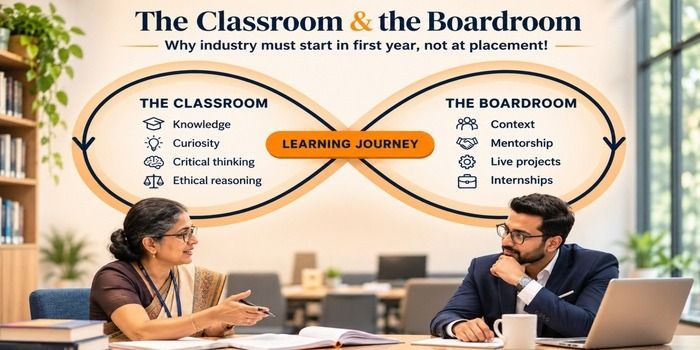
Universities and businesses bring different, equally important strengths to a knowledge economy. Educational institutions cultivate knowledge, intellectual depth, research, curiosity and independent thinking. Industry brings the realities of application, shaped by technology, changing consumer expectations, competition and practical business challenges. It demonstrates how decisions are made, ideas are tested and solutions implemented.
Neither can replace the other. Universities should not become corporate training centres, just as businesses cannot take on the role of academic institutions. The objective is to connect what students learn with how knowledge is applied in the real world.
When these strengths complement each other, students learn to connect knowledge with action, theory with practice and ideas with outcomes.
Industry-Academia Collaboration Must Begin Before Recruitment
Businesses must engage with educational institutions well before campus placements. They can contribute to curriculum discussions, share insights into emerging technologies and market requirements, and involve experienced professionals in mentoring and academic discussions.
Internships and apprenticeships offer practical exposure, while live projects allow students to work on real business or community challenges. Research partnerships can help translate academic knowledge into solutions, products and innovation.
Such engagement should not be limited to final-year students. Industry exposure and practical problem-solving can become progressive parts of the learning journey. This requires sustained engagement between faculty, institutional leaders and business professionals, with companies investing time and intellectual resources rather than treating campus engagement as a periodic recruitment exercise.
The objective is not simply to make students immediately employable, but to help them understand how their knowledge can create value.
The Relationship Must Create Value for Both Sides
Industry-academia partnerships are not just a responsibility of businesses towards educational institutions. They also offer significant value to industry.
Businesses gain access to emerging talent, fresh perspectives, academic research and new ideas. Universities gain a deeper understanding of practical challenges, evolving technologies and economic needs. This exchange can encourage applied research, support innovation and create opportunities for new products, services and enterprises.
For businesses, engagement with academia offers a view of ideas and capabilities that may shape their industries in the years ahead. For universities, it creates pathways for research and knowledge to contribute to economic and social development.
The most effective partnerships are long-term relationships built on mutual respect, shared objectives and a willingness to learn from each other.
Education Must Develop Job Creators, Not Just Job Seekers
Employability is an important outcome of education, but it should not be its only measure.
India needs capable professionals who can contribute to established organisations, as well as entrepreneurs, innovators and problem-solvers who can create businesses, generate employment and open new opportunities.
Education must therefore encourage initiative, independent thinking, creativity and the confidence to turn ideas into viable enterprises.
Businesses can expose students to entrepreneurship, business models and the realities of building and managing organisations. Mentorship, incubation support and industry projects can help young people understand how ideas move from conception to execution.
Universities, meanwhile, must nurture curiosity, critical thinking, communication, ethical reasoning and independent learning. Not every student will become an entrepreneur, but every student should have the opportunity to develop an entrepreneurial mindset: the ability to identify opportunities, take initiative, solve problems and create value.
Developing these capabilities is a shared responsibility. Industry must contribute, while universities preserve the intellectual breadth that helps students adapt beyond today’s job descriptions.
Building India’s Knowledge Economy Requires a Shared Commitment
As India advances towards its ambition of becoming a developed nation by 2047, the quality of its human capital will matter as much as its physical and economic infrastructure. A knowledge economy is not built merely by producing more graduates. It depends on the ability to generate knowledge, apply it, innovate, create enterprises and translate ideas into economic and social progress.
This calls for educational institutions that encourage discovery, businesses that invest in people and ideas, and partnerships that connect learning with society’s needs.
As technology and artificial intelligence transform industries, students will need sound judgement, adaptability, creativity, and a commitment to lifelong learning. These capabilities cannot emerge through recruitment programmes alone. They require a connected learning ecosystem where academia, industry, and society work together.
Ultimately, education and enterprise must not operate as disconnected stages of development. Both have a role in building a more capable, innovative and entrepreneurial India. Industry should not be the final destination of education. It should actively participate in the learning journey.
Frequently Asked Questions
1. What is industry-academia collaboration?
Industry-academia collaboration is a partnership between businesses and educational institutions to connect academic learning with practical industry experience. It can include curriculum inputs, internships, apprenticeships, mentorship, live projects, research partnerships and innovation initiatives.
2. Why is industry-academia collaboration important for India?
It connects education with changing economic and technological needs, strengthens practical learning, encourages research and innovation, and builds the skills needed for employment and entrepreneurship. It can also help build a stronger talent and innovation ecosystem for India’s knowledge economy.
3. How can businesses participate in education beyond campus placements?
Businesses can engage with universities through mentorship programmes, guest lectures, curriculum discussions, internships, apprenticeships, live industry projects, faculty development, research partnerships and entrepreneurship initiatives. Sustained engagement can make industry participation part of the learning journey rather than a recruitment-stage activity.
4. Does industry involvement mean universities should become job-training centres?
No. Universities must retain their role in developing knowledge, critical thinking, research, independent inquiry and intellectual depth. Industry participation should complement academic learning by providing practical context and exposure to real-world challenges, not narrow education to immediate workplace requirements.
5. How can education encourage students to become entrepreneurs and job creators?
Educational institutions can nurture curiosity, independent thinking, problem-solving and initiative. Industry can complement this through mentorship, exposure to business models, incubation support, live projects and opportunities to understand how ideas become viable enterprises.
6. When should industry engagement with educational institutions begin?
It should begin well before campus recruitment. Early, progressive engagement through mentorship, practical exposure, industry projects, and research partnerships can help students connect their academic learning with real-world applications throughout their education.
Suggested Reads

Discover more from Niranjan Hiranandani
Subscribe to get the latest posts sent to your email.