

 By
By For decades, India’s demographic dividend has been discussed primarily as a story of numbers: a large and relatively young population, a growing working-age cohort and the potential to become one of the world’s largest labour forces. But population by itself does not create prosperity. The real opportunity lies in what we do with that population.
India’s next demographic transition must therefore be from population advantage to productivity advantage and ultimately to global talent advantage.
India today has a remarkably large working-age population. Around 68% of the country’s population is between 15 and 64 years of age. But demographic advantage is not automatic. It becomes an economic advantage only when people are healthy, educated, skilled, productive and connected to meaningful opportunities. The global context makes this opportunity particularly important.
Across economies, demographics are moving in different directions. Ageing populations and shrinking workforces are creating structural labour shortages in several developed markets, even as technology is transforming the nature of work. The World Economic Forum estimates that by 2030, structural changes could create 170 million jobs while displacing 92 million others. At the same time, 39% of workers’ key skills are expected to change.
The implication is significant: the world will not simply need more workers. It will need people with the right skills, in the right sectors, with the ability to adapt and work across increasingly interconnected markets. That is where India’s opportunity begins.
From Workforce Scale to Workforce Capability
India already has scale; the challenge is to convert that scale into capability. There is a revealing paradox here. Indian employers continue to report significant difficulty finding the talent they need, even as the country has one of the world’s largest labour pools. This tells us something important: having people is not the same as having employable human capital.
Our approach to skilling must therefore evolve. Success cannot be measured simply by how many people have completed a training program. The more important questions are: Are their skills aligned with actual industry demand? Are their qualifications credible and portable? Are they ready for the workplace? Can they communicate effectively? And can their capabilities be recognized beyond the geography in which they were acquired?
This is the missing middle between India’s workforce and the world’s demand for talent:
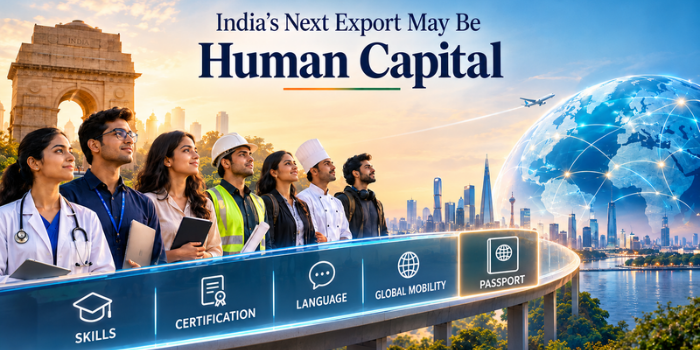
Skills → Certification → Language → Industry Readiness → Mobility → Global Employer Linkage
A technically qualified worker seeking an opportunity in Germany, Japan, or another international market may require much more than technical competence. International certification, language proficiency, familiarity with workplace practices, documentation, cultural readiness and access to a credible employer can determine whether that individual is genuinely employable in another market. This is why skilling must increasingly be treated as economic infrastructure.
We build ports to connect Indian goods with global markets. We build digital infrastructure to connect Indian businesses with customers around the world. We now need to build equally credible institutional infrastructure that connects Indian talent with global demand.
Building the Architecture for Global Talent Mobility
Maharashtra’s Global Circular Workforce Mobility Policy 2026 is one such example. The policy proposes country-specific skill passports, alignment of training with international requirements, language capabilities, certification, documentation, and safer recruitment pathways. It aims to facilitate overseas employment opportunities for 100,000 workers over five years.
What is important about this approach is not simply the number of people who may eventually work overseas. Its significance lies in recognizing that international mobility requires an ecosystem around the worker.
It requires understanding what Germany needs from a technician, what Japan needs from a caregiver, and what another market requires from an engineer or skilled tradesperson then building the training, certification, and recruitment architecture around those requirements.
This principle should extend well beyond one state. India can progressively develop structured talent corridors between Indian training institutions and international employers, with governments, industry, educational institutions and employers working together. The objective should also be circular, not one-directional.
Workers who gain international experience can return with new skills, technologies, management practices, global exposure and capital. If the ecosystem enables that knowledge to flow back into Indian industry, international mobility can also strengthen domestic productivity.
From Labour Export to Global Talent Partnership
India has already demonstrated that its human capital can become globally competitive. The IT and services industries showed how Indian talent could serve customers, businesses and institutions across borders.
The next opportunity is much broader. Healthcare, advanced manufacturing, engineering, construction, logistics, renewable energy, semiconductors, digital technologies and skilled services will all create new talent requirements as economies transform.
India should aspire not merely to supply labor to the world but to be a trusted global talent partner. That distinction matters. A trusted talent partner is one whose workers are appropriately skilled, certified, adaptable and professionally prepared; whose qualifications can be understood across markets; and whose mobility is safe, transparent and supported by credible institutions.
The demographic window will not remain open indefinitely. India therefore has an opportunity today to build the capabilities and institutions that will determine whether its demographic dividend becomes a lasting economic dividend. Our competitive advantage in the coming decades may not be simply that India has more people of working age. It may be that India can develop more people with the capabilities the world needs.
We have the workforce. The world has the demand. India’s opportunity is to build the bridge between the two.
Follow Us On Social Media:
Discover more from Niranjan Hiranandani
Subscribe to get the latest posts sent to your email.