
 By
When we conceived Hiranandani Gardens Powai, the plan was never simply to build housing and add green space wherever it happened to fit. An integrated township is planned as one system, residences, schools, hospitals, retail and open space, designed together, not stitched together after the fact. Nirvana Park is one of the clearest expressions of that planning philosophy.
In a suburb where every acre carries enormous commercial value, setting aside four acres at the centre of the township, not its edge, for a garden was a deliberate planning decision. It reflects a principle I have held through four decades of building integrated communities: that a township’s long-term worth is measured as much by what it protects as by what it constructs.
Green Space as Planning, Not An Amenity
‘Nirvana’ means a state of complete peace, and the name was chosen deliberately. The park was never designed as a decorative afterthought to the residential blocks around it. It was planned as core infrastructure, in the same category as roads, schools and utilities, because a dense urban township without genuine open space eventually strains the very community it was built to serve.
A Japanese-Inspired Garden, Designed With Intent
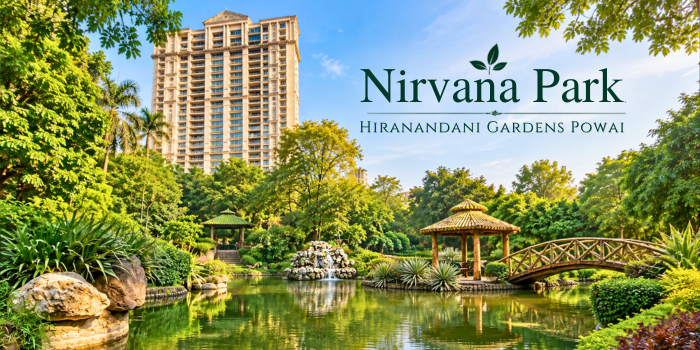
The design language within the park, Japanese-inspired landscaping using rock, gravel and water to recreate the calm of a natural setting, along with stone reflexology paths that add a wellness feature to the walking experience, follows from the same planning logic. A rock garden, ornamental sculptures, a treehouse, cabanas and a summer house are built into the landscape rather than placed on top of it.
None of this was designed in isolation from the township around it. Every element serves the same underlying purpose that governs the rest of Hiranandani Gardens Powai’s planning: giving residents of a dense, fast-moving city somewhere within their own community to slow down, without having to leave it.
Sustainability Designed Into the System, Not Added to It
Nirvana Park’s ecosystem illustrates a broader point about how we approach sustainability across our townships: it is planned into the infrastructure from the outset, not retrofitted once a development is complete. Water management was integrated into the township’s infrastructure from the outset, the same principle that has shaped how we plan water, waste and green cover across every integrated community we have built since.
The park’s pond, spanning roughly 2,300 square metres and home to Koi Carp, goldfish, tilapia, guppies and sucker catfish, and the birdlife it draws through the year, including the Coppersmith Barbet, the Small Green Bee-eater, the Purple-rumped Sunbird, the Red-vented Bulbul, the Little Cormorant, the Blue Rock Pigeon, the Cattle Egret, the Black Kite, the Great Egret and the White-throated Kingfisher, reflect the ecological value that well-planned green spaces can create within a dense urban environment.
What the Name Change Does Not Change
Current signage at the park carries the name Shri Chhatrapati Shivaji Maharaj Udyan. The park continues to be popularly known as Nirvana Park, the name it has carried since the community first shaped it in the mid-1990s. What has not changed, regardless of the name on the gate, is the planning intent behind the space itself.
The Principle Behind Every Township We Build
As I have said before: “It is cardinal to emphasise striking a balance between the ecology and the habitat we live in. Developers need to have a more balanced approach in their green policies and practices, optimising the use of resources to achieve an ecologically sustainable lifestyle. We need to create an abode that is environmentally conscious for humankind to exist perennially. We, at Hiranandani, are the torchbearers of green living, which we have been practising across all our projects since our inception.”
Nirvana Park is not an isolated feature of Hiranandani Gardens Powai. It is a working demonstration of the same integrated planning philosophy that has since shaped every township we have built, treating green space, sustainability and community infrastructure as part of one designed system rather than separate additions. As Mumbai continues to grow denser, that approach to planning, not any single amenity, is what determines whether a township remains liveable decades after it is built.
Dr Niranjan Hiranandani is Co-founder of the Hiranandani Group and Founder and Chairman of Hiranandani Communities.
Follow Us On Social Media:
More to explore