

 By
By Reliability is not a feature; it is a feeling.
Buying a home is often described as one of the biggest financial decisions a person will make. In my experience, it is something far more profound. It is one of life’s emotional decisions. Behind every home purchase lies years of hard work, disciplined savings, and the aspiration to build a better future. Buyers certainly evaluate location, price, connectivity, floor plans, amenities, quality, and developer’s vision. But once every comparison has been made, one question invariably remains: Can I trust this place with my future?
Can I trust the quality of the home I am buying? Can I trust the developer to deliver what has been promised? Can I trust that the neighbourhood will continue to evolve? Can I trust that my children will grow up in a safe and enriching environment? Can I trust that this decision will continue to feel right ten or twenty years from now?
This, to me, is the true meaning of reliability. Reliability is not merely a project feature or a construction milestone. It is an emotion. It is the confidence that the place you choose today will continue to support your family’s aspirations tomorrow. It is the reassurance that your investment is backed not only by a well-built home, but by a thoughtfully planned ecosystem capable of growing with you. As Mumbai enters its next phase of urban evolution, often referred to as Mumbai 3.0, I believe reliability will become one of the most valuable attributes any township can offer.
Why Reliability Has Become More Important Than Ever
The expectations of today’s homebuyers are very different from what they were even a decade ago. People are no longer buying homes simply because they are close to work or because they offer larger apartments. They are choosing environments that can support the way they want to live. The rise of integrated townships, expanding infrastructure, improving connectivity, and new economic centres has given buyers far more choice than ever before. But with greater choice comes greater scrutiny.
Today’s buyers are asking better questions.
Will this neighbourhood remain relevant in the future? Will my daily life become easier? Will my children have access to quality education and open spaces? Will this community continue to develop long after I move in?
In other words, buyers are looking beyond the apartment. They are evaluating the ecosystem.
That is why I believe reliability has become the new currency of homeownership. It is no longer enough to deliver a home. The larger responsibility is to create confidence about everything that surrounds it.
Quality Is the First Language of Trust
Trust begins with quality. Not just the quality that is immediately visible, but the quality that reveals itself over time. It begins with thoughtful planning, durable construction, efficient design, and disciplined execution. It extends to the roads that connect the community, the landscaped spaces that encourage interaction, the infrastructure that supports everyday living, and the attention to detail that residents experience long after possession.
Quality cannot stop at the apartment door. A home may be beautifully designed, but if the surrounding infrastructure fails to keep pace with the needs of a growing community, the experience gradually diminishes. True quality therefore lies in creating an environment where every element works together to improve everyday life.
This philosophy has shaped our developments for more than four decades. Whether it is the quality of the product, the quality of construction, the quality of execution, or the quality of the overall living environment, the objective has always remained the same: to create places that people can depend upon, not just admire.
Because reliability is ultimately built one experience at a time.
A Home Is Experienced Beyond Its Four Walls
One of the biggest misconceptions in real estate is that people buy homes. In reality, they buy a way of life. The true value of a home is rarely measured by square footage alone. It is experienced in the rhythm of everyday living.
It is the convenience of having essential services nearby. It is the comfort of spending less time commuting and more time with family. It is the freedom children enjoy when they have access to healthcare, all part of a thoughtfully planned environment. These moments rarely appear in a project brochure. Yet they are the experiences that define whether a house truly becomes a home.
This is why I have always believed that successful townships should be designed around people rather than buildings. A well-planned integrated township allows families to live, work, learn, socialise and grow within one connected ecosystem. It creates opportunities for interaction, encourages healthier lifestyles and gives residents something that has become increasingly valuable in modern cities: a genuine sense of belonging.
People trust places where relationships grow naturally. They trust communities where neighbourhoods become friends, children build lifelong memories and families feel connected to something larger than their individual homes.
In many ways, belonging is the highest expression of reliability.
Trust Is Earned Long After Possession
A home is one of the most significant investments a family makes. It represents years of savings, careful planning, and aspirations for the future. Naturally, homebuyers seek more than attractive designs or impressive amenities; they seek assurance that the promises made today will be honoured tomorrow. In real estate, trust cannot be created through typical promotions; rather, it can be earned through consistent delivery. It is reflected in the ability to complete projects with delivery and discipline. It is strengthened when communities continue to evolve after residents move in. It grows when homebuyers realise that the developer’s commitment extends well beyond handing over possession.
Over the last four decades, this philosophy has shaped every Hiranandani development. From Powai to Thane, and from Chennai and Alibaug to Panvel, our objective has never been limited to constructing buildings. It has been to create destinations that continue to mature with time. Roads improve, commercial activity expands, educational institutions become operational, community spaces come alive, and neighbourhoods develop their own identity.
That is the difference between building homes and building communities. The relationship with a homebuyer does not end when the keys are handed over. In many ways, that is when our responsibility truly begins.
For me, reliability is measured years after a project is delivered, when families continue to feel that they made the right decision.
Why Panvel Represents the Next Chapter of Mumbai 3.0
Every city reaches a point where its growth begins to extend beyond its traditional boundaries. Mumbai is now at that stage. With transformative infrastructure such as the Mumbai Trans Harbour Link (Atal Setu), the Navi Mumbai International Airport, expanding metro connectivity and improved road and rail networks, the city’s centre of gravity is gradually shifting. Panvel is emerging as one of the most important beneficiaries of this transformation.
However, infrastructure alone does not create thriving urban centres. It creates the foundation upon which businesses, employment, education, healthcare, retail and social infrastructure can flourish. As these elements develop together, they create vibrant, self-sustaining communities rather than isolated residential clusters.
This is also why Panvel requires more than standalone residential developments. As the region grows into a significant economic and urban centre, people will need complete ecosystems that bring homes, workplaces, education, healthcare, retail, recreation and community infrastructure closer together. The future of Panvel will therefore depend not only on how many homes are built, but on how comprehensively the places around them are planned.
A region undergoing such rapid transformation cannot be shaped by isolated developments alone. As new infrastructure brings people, businesses and opportunities into Panvel, the need is for places that can integrate the different dimensions of everyday life and grow alongside the wider region. This is why an integrated township approach becomes essential to Panvel’s next phase of development.
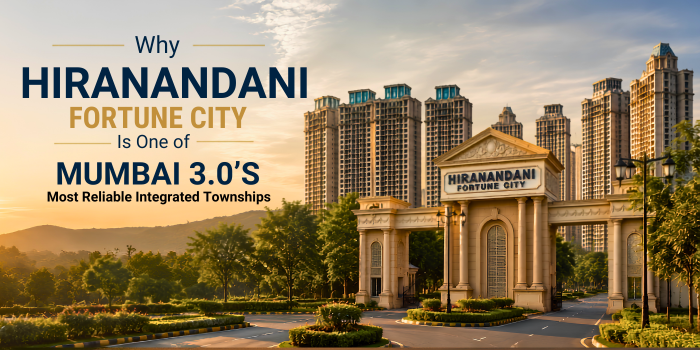
This is precisely why Hiranandani Fortune City Panvel has been envisioned as an integrated township and not merely a housing development. The vision extends beyond delivering homes. It is about creating an ecosystem where residential, commercial, educational and recreational spaces complement one another, making everyday life more convenient, connected and fulfilling.
When families can live, work, learn and spend quality time within a well-planned environment, reliability becomes a lived experience rather than a promise.
Reliability Creates Long-Term Confidence
People often ask what creates long-term value in real estate. While location will always remain important, I believe long-term value is created by something much larger: the strength of the ecosystem.
A well-planned township benefits from multiple reinforcing factors. Better infrastructure improves accessibility. Economic activity creates employment. Employment attracts families. Growing communities encourage retail, and all the required external infrastructure that binds a swift lifestyle. Together, these elements create an environment that becomes increasingly desirable over time.
This is why integrated townships can create value that extends well beyond the apartment itself.
More importantly, they create confidence. Confidence that daily life will become easier. Confidence that the neighbourhood will continue to evolve. Confidence that the community will remain relevant for future generations.
And confidence that one of life’s most important decisions will continue to feel like the right one for many years to come. Ultimately, that is what every homebuyer seeks.
Not just appreciation in property values, but appreciation in the quality of life.
The Future Belongs to Places People Can Trust
Mumbai 3.0 will undoubtedly reshape the city’s geography. New infrastructure will improve connectivity. New business districts will emerge. New skylines will redefine the region.
But the true success of this transformation will not be measured by kilometres of highways or the height of buildings.
It will be measured by the quality of the communities we create around them.
The townships that endure will be those that offer more than homes. They will provide trust. They will provide comfort, convenience, opportunity and belonging. They will create environments where families feel secure, businesses can flourish, and communities continue to grow stronger with every passing year. That has always been the philosophy behind Hiranandani Communities.
Our aspiration has never been to build projects that simply respond to today’s demand. It has been to create places that remain relevant for generations. That is because the true measure of a township is not how impressive it appears on the day it is launched. It is how confidently people can build their lives there over the decades that follow.
In the end, reliability is not something that can be measured by specifications or amenities alone. It is reflected in the confidence a family feels when they choose a home. It is reinforced by quality, strengthened through consistent delivery and sustained by a community that continues to evolve with time.
That is why I believe the most valuable amenity in Mumbai 3.0 is not luxury. It is reliability.
Because when people trust the place they call home, they are not simply investing in real estate. They are investing in their future.
And that is the enduring promise of Hiranandani Fortune City Panvel: to create not just a home, but a place people can continue to trust as they build their future.
Follow Us On Social Media:
Discover more from Niranjan Hiranandani
Subscribe to get the latest posts sent to your email.