

 By
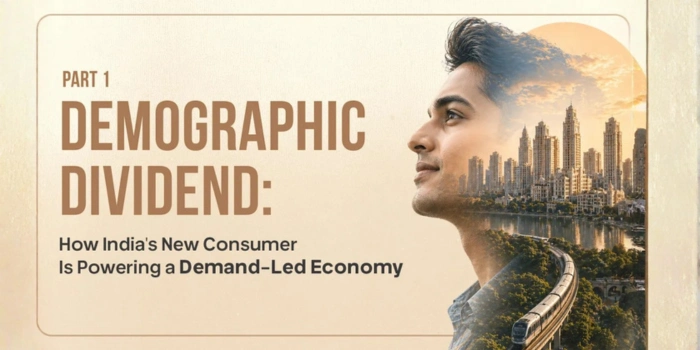
Over the past few decades, India’s economic narrative has often referenced its demographic dividend as a future advantage. Today, that dividend is no longer a distant promise; it is a present, visible force reshaping how the country consumes, invests, and creates wealth. What we are witnessing is not just population growth, but the emergence of a consumption-ready, aspiration-driven demographic that is fundamentally altering the trajectory of India’s economy.
From Demographics to Demand: A Structural Shift
India stands apart in a world where many developed economies are grappling with ageing populations. With a median age of approximately 29.5 years and nearly 68% of its population in the working-age bracket, India has a distinct structural advantage.
However, demographics alone do not create economic momentum. What makes India’s position unique today is how this young population is actively participating in the economy, not just as earners, but as consumers, investors, and asset creators. The shift from a supply-driven to a demand-led economy is now clearly visible. Consumption is no longer constrained by necessity; it is increasingly driven by aspiration.
The Rise of an Aspirational, Financially Aware Consumer
A defining feature of this new India is the emergence of a financially aware and confident consumer class. The rapid expansion of capital market participation is a strong indicator. With over 225 million Demat accounts, financialisation of savings has accelerated significantly. Investment is no longer limited to traditional instruments; equities, digital platforms, and new-age assets are becoming mainstream, particularly among younger Indians.
Equally significant is the rise of first-generation wealth creators, driven by a thriving startup and entrepreneurship ecosystem. With over 125 unicorns, India is witnessing a shift where wealth is no longer inherited; it is being built. Interestingly, this change is visible even at the earliest stages of earning. A growing number of young professionals are choosing to invest their first salary, reflecting a mindset shift from consumption-first to wealth-creation-first.
Earlier Entry into Asset Ownership
This financial confidence is translating into earlier participation in asset ownership, particularly in real estate. The average age of a homebuyer in India has dropped to the early 30s. This is a significant shift from previous decades, where homeownership was often a late-life decision.
Today’s consumer is not waiting. Access to credit, rising incomes, global exposures, and greater financial awareness are enabling younger individuals to enter the property market sooner, marking a structural change in demand patterns.
The Evolving Role of Women in Economic Decision-Making
Another powerful transformation is the growing role of women as independent economic stakeholders. Women today are not just participants in household financial decisions; they are increasingly leading them. This shift is influencing consumption patterns, investment choices, and asset ownership across sectors. In real estate, this translates into a more nuanced demand where safety, accessibility, and long-term value are evaluated with greater depth and intent.
Changing Households, Changing Consumption
India’s demographic dividend is also being shaped by evolving social structures. Traditional family models are giving way to more diverse formats:
- DINK (Double Income, No Kids) households
- Delayed parenthood
- Nuclear family setups
These shifts are subtle, but their impact on consumption is profound.
A dual-income household with fewer immediate responsibilities has higher disposable income and a higher propensity to spend on lifestyle, experiences, and quality of living. The mindset is no longer centred on survival; it is driven by aspiration and self-improvement.
The Digital Layer: Aspirations Without Boundaries
Digital exposure has played a catalytic role in shaping this new consumerist economy. The digital universe enables tapping into global insights and trends, influencing the lifestyles, products, and experiences of aspirational consumers. This has elevated expectations across categories from housing to mobility to lifestyle consumption. The result is a consumer who is not only more informed but also more demanding in terms of quality, experience, and value.
A New Economic Reality
When we connect these threads, demographics, financialisation, entrepreneurship, changing households, and digital exposure, a clear picture emerges. India is no longer an economy waiting to unlock its potential. It is already operating as a demand-led system, where consumption, aspiration, and asset creation are reinforcing each other. This is a fundamental shift.
Looking Ahead
The implications of this transformation extend across sectors, but perhaps nowhere are they more visible than in real estate. As the Indian consumer evolves, so too will the nature of demand, like what people buy, how they evaluate value, and what they expect from their investments.
If this establishes how the consumer has changed, the next question becomes inevitable: How is this new, aspirational India reshaping real estate demand?
That is the lens through which we will explore the next part of this series.
India’s demographic dividend is no longer a future consumption story. It is a present-tense demand engine, actively redefining how the economy grows and how value is created.
Follow Us On Social Media:
Discover more from Niranjan Hiranandani
Subscribe to get the latest posts sent to your email.
2 Comments
Comments are closed.