

 By
By India’s aspiration to become a $10 trillion economy will not be determined by growth alone. It will be determined by how successfully it builds energy security, industrial resilience, and strategic self-reliance.
Economic sovereignty begins with energy sovereignty.
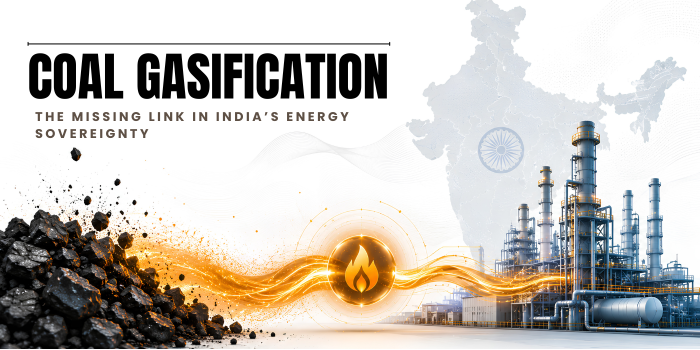
One of the most underutilised opportunities in the journey lies in coal gasification, a technology that has the potential to transform India’s abundant coal reserves into the foundation of a stronger industrial economy.
Despite possessing the world’s fourth-largest coal reserves, over 380 billion tonnes, India continues to spend more than ₹1 lakh crore annually importing urea, LNG, methanol, ammonia, fertiliser feedstocks, and other industrial chemicals. For a nation endowed with such vast natural resources, this dependence represents not merely an economic inefficiency but a strategic vulnerability.
Nations become economically powerful not when they consume resources, but when they create value from them.
I believe coal gasification offers India one of its most significant opportunities to strengthen energy sovereignty, reduce import dependence, and build long-term industrial resilience.
Beyond Electricity: Reimagining Coal’s Role Through Coal Gasification
For decades, coal has largely been viewed as a fuel for thermal power generation. That perspective is increasingly outdated. Today, leading industrial economies recognise coal as a valuable raw material for manufacturing.
Through coal gasification, coal is converted into synthetic gas (syngas), which serves as the building block for a wide range of industrial products that India currently imports in significant quantities, including:
- Urea
- Ammonia
- Methanol
- Synthetic Natural Gas (SNG)
- Petrochemicals
- Synthetic fuels
Simply put, coal gasification enables India to convert a domestic resource into high-value industrial feedstocks that support manufacturing, agriculture, and chemical industries. It is not an experimental concept—it is a mature industrial technology already deployed successfully across several countries.
India’s Import Dependence: A Strategic Challenge
India’s energy challenge extends well beyond crude oil. Today, the country imports over 90% of its methanol requirements and more than 80% of its LNG. It also depends heavily on imported ammonia and fertiliser feedstocks while continuing to import around 4 million tonnes of urea annually, despite being one of the world’s largest consumers of fertilisers.
This dependence exposes the economy to volatile global commodity prices, geopolitical disruptions, supply chain uncertainties, and currency pressures. Recent global events have demonstrated how quickly international conflicts and logistics disruptions can affect domestic industries.
Strategic autonomy cannot coexist with structural dependence. Reducing imports is therefore not simply an economic objective; it is a national imperative.
Fertiliser Imports: An Opportunity Hidden in Plain Sight
Few sectors demonstrate India’s import dependence more clearly than fertilisers, where agriculture, energy security, and industrial policy intersect.
India consumes nearly 30 million tonnes of urea annually, yet continues to import around 4 million tonnes while relying heavily on imported natural gas for domestic production.
The financial implications are equally significant. India’s fertiliser subsidy now stands at nearly ₹1.9 lakh crore, with urea accounting for the largest share. While these subsidies remain essential for protecting farmers, reducing dependence on imported feedstocks would improve the long-term sustainability of the entire system while strengthening India’s energy sovereignty.
The Strategic Inflection Point India Cannot Afford to Miss
Every generation of industrial growth has been defined by one foundational capability. Steel powered the manufacturing revolution. Information technology accelerated the digital economy.
Coal gasification has the potential to become one of the foundational industrial capabilities that strengthens India’s next phase of manufacturing-led growth.
As someone who has spent decades building businesses across multiple economic cycles, I have learnt that transformative opportunities often emerge long before they become obvious.
Coal gasification represents one such inflexion point. The real opportunity is not merely replacing imports. It is about creating entirely new industrial ecosystems around India’s domestic resources.
Countries that build enduring economic strength are those that convert natural resources into integrated manufacturing capabilities. The move is beyond exporting or consuming raw materials and instead creates value chains that generate employment, attract investments, build technological capabilities, and strengthen national competitiveness.
India stands at precisely such a moment today.
India Has Already Recognised the Opportunity
India has already begun laying the foundation for this transition. The Government’s National Coal Gasification Mission, backed by nearly ₹85,000 crore of planned investment and a target of 100 million tonnes of coal gasification capacity by 2030, reflects an important strategic shift.
The policy intent is clear; the next challenge is execution.
Infrastructure alone will not transform India’s industrial landscape. Success will depend on building complete coal-to-chemicals ecosystems rather than isolated projects.
The China Lesson: Industrial Ecosystems Create Competitive Advantage
China offers perhaps the strongest example of what this approach can achieve. Its success in coal gasification was never simply about adopting superior technology. It was the result of a long-term industrial strategy that viewed coal not merely as an energy source but as the foundation of an integrated manufacturing ecosystem.
Instead of developing standalone gasification plants, China established large coal-to-chemicals industrial clusters located close to coal reserves. Around each gasification facility grew interconnected industries producing fertilisers, methanol, ammonia, petrochemicals, and downstream manufacturing.
This ecosystem approach fundamentally changed project economics. Shared infrastructure reduced costs; integrated demand improved commercial viability, logistics became more efficient, and businesses benefited from scale that individual projects could never achieve independently.
That is perhaps the most important lesson for India.
Individual factories rarely create industrial competitiveness. It is built through ecosystems where industries reinforce one another, attract further investment, and generate long-term economic momentum.
India’s Opportunity Is Even Greater
India has the opportunity not merely to replicate China’s approach, but to build a next-generation industrial ecosystem aligned with its own strengths and manufacturing ambitions.
Future coal gasification projects should evolve into integrated industrial ecosystems, where gasification plants operate alongside fertiliser, methanol, ammonia, petrochemical manufacturing, logistics infrastructure, water recycling systems, carbon management facilities, and downstream industries that create sustained domestic demand.
Such ecosystems can transform coal-rich regions into engines of industrial growth, generating employment, attracting private investment, strengthening regional economies, and significantly improving India’s manufacturing competitiveness.
This is where public policy becomes particularly important. Viability gap funding, long-term offtake mechanisms, technology partnerships, regulatory certainty, and financial incentives can enable large-scale deployment.
Coal Gasification and Sustainability Can Progress Together
Supporting coal gasification is not about consuming more coal. It is about creating greater value from the coal India already possesses.
Modern coal gasification offers carbon capture opportunities, continuous environmental monitoring, and cleaner industrial processes than traditional coal utilisation. These sustainability measures are most effective when incorporated into project design from the beginning rather than added later.
Equally important, the discussion should not be framed as a choice between coal and renewable energy. Renewables remain indispensable for decarbonising electricity generation. Coal gasification addresses an entirely different challenge: producing secure domestic supply for chemicals, fertilisers, and industrial manufacturing, areas where renewable energy currently cannot offer complete substitutes.
Both will remain essential pillars of India’s long-term energy strategy.
Building Industrial Value Chains, Not Just Replacing Imports
The long-term impact of coal gasification extends well beyond import substitution. Executed at scale, it can strengthen energy sovereignty, reduce fertiliser imports, expand domestic methanol and ammonia production, improve manufacturing competitiveness, conserve foreign exchange, stimulate industrialisation across coal-bearing states, and generate large-scale employment.
More importantly, it enables India to convert one of its greatest natural advantages into enduring economic strength. That is the true spirit of Atmanirbhar Bharat.
Self-reliance is not about isolation from the global economy. It is about ensuring that India’s growth is built upon resilient domestic capabilities.
India possesses the resources. The technology is proven. Policy direction has begun to align. Industrial demand continues to grow. The next phase requires building coal-to-chemicals value chains that maximise the potential of these advantages. History consistently shows that nations create lasting economic strength not by exporting resources, but by building industries around them. Coal gasification presents India with exactly that opportunity, not simply to produce chemicals and fertilisers but to reshape its industrial future through integrated manufacturing ecosystems.
Infrastructure creates capacity. Ecosystems create competitiveness.
The question is no longer whether India possesses the resources to build industrial self-reliance. It does. The real question is whether we can build the ecosystems that convert those resources into long-term national strength.
If India is serious about achieving long-term energy sovereignty, strengthening manufacturing, and becoming a truly resilient global economic power, this is no longer an opportunity to observe; it is an opportunity to build.
Follow Us On Social Media:
Discover more from Niranjan Hiranandani
Subscribe to get the latest posts sent to your email.