

 By
The true success of a township is not measured by when the last tower is completed, but when businesses begin to flourish, livelihoods are created, and communities become self-sustaining. This is the real test of urban development, not how the skyline looks, but how an economy behaves once people move in.
At Hiranandani Communities, we have always believed that our role extends beyond creating landmark developments. Our purpose is to create geographic places that reshape how people live, work, and grow.
Places that reshape how people live, work, and grow. A development is not finished when construction ends; it is finished when it starts generating activity of its own: jobs, businesses, schools, services, and the everyday momentum of a place that no longer needs anyone’s help to keep growing. Whether at Hiranandani Gardens Powai, Hiranandani Fortune City Panvel, Hiranandani Parks Chennai, or our emerging work in Alibaug, the underlying philosophy has stayed constant.
Build places that create opportunity first and let the value follow.
Townships, in my view, should create opportunity before they create appreciation. Real estate that only appreciates has succeeded financially. Real estate that creates jobs, enables businesses, and improves daily life has succeeded as a city-building exercise. That distinction matters more today than ever.
Powai: How a Suburb Became a Benchmark
When we began work at Hiranandani Gardens, Powai was an underdeveloped suburb on Mumbai’s map, not a destination. What changed its trajectory was not the pace of construction, but the sequencing of what was built and why.
Homes alone do not attract businesses; density and intent do.
As the residential blocks took shape, we deliberately introduced schools, healthcare, retail, and hospitality alongside them, rather than waiting for the demand to justify each addition. That decision then reversed the usual order of urban growth. Businesses did not wait for Powai to become viable; they became partners in creating that viability because the integrated community offered something most Mumbai suburbs could not: planned infrastructure, a growing residential base, and an environment designed for commercial activity rather than merely accommodating it.
Commercial presence, in turn, accelerated the residential demand.
Professionals wanted to live close to where they worked; institutions wanted to be close to the population they served. Education and healthcare complemented retail and hospitality, and each sector’s growth created pull for the next, knitting the planned community into a self-reinforcing whole.
This differentiates a township from a suburb: a suburb absorbs growth that happens elsewhere, while a township generates its own.
That is why Powai did not simply develop: it became a destination. It still draws investment, talent, and enterprise today, even decades after the first homes were handed over, because the place was built to sustain itself, not just to sell apartments.
The Multiplier Effect of Township Development
A township does not create a single type of job; rather, it sets off a chain reaction across four layers of the economy. The first is direct employment: architects, engineers, contractors, and skilled labour, engaged through construction itself. The second is indirect employment, which follows once people move in: facility management, security, transport, landscaping.
The third is entrepreneurship: the schools, clinics, hotels, and retail outlets a growing population attracts, each owned and staffed by someone betting on that population’s permanence. The fourth, and often the most durable, is the recurring service economy– the shops, restaurants, and providers that exist only because a stable population needs them every single day long after the construction layer has gone quiet.
This is the multiplier effect of integrated township development. One well-planned development does not just build once and employ once: it keeps generating livelihoods for decades, long after the cranes have left the site. Cities become stronger, I believe, when employment grows closer to where people live, because it reduces commute-driven stress, strengthens local economies, and gives residents a stake in the place they inhabit, not just a postal address.
Why Entrepreneurs Choose Integrated Communities
That third layer, entrepreneurship, deserves a closer look, because it behaves differently inside a planned community than it does in the open market. For small businesses and entrepreneurs, an integrated community offers something the open market cannot: predictability. A planned population base means a predictable customer pool. Planned infrastructure means lower operating uncertainty. Higher footfall, generated by residents, visitors and institutions all sharing the same neighbourhood, gives a cafe, a clinic or a retail outlet better unit economics than the same business would see in an unplanned, scattered market.
Over time, this predictability compounds into a higher-quality ecosystem: better service providers attract better customers, who in turn attract better service providers. The cycle is what
gives entrepreneurs within a self-sustaining community a genuine shot at long-term business sustainability rather than a single good season followed by an uncertain future.
One Philosophy, Different Regional Roles
While each township serves a different regional need and context, they are all guided by the same philosophy of integrated development- creating ecosystems that generate opportunity, strengthen local economies, and build communities designed to thrive over the long term.
The principle that transformed Powai now shapes our work across India, but each location contributes differently to the regional economy it serves. Powai demonstrates how integrated planning can transform an underdeveloped suburb into a self-sustaining urban district.
Panvel is positioned to support the Mumbai Metropolitan Region (MMR)’s expanding growth corridor as new infrastructure reshapes the region, creating an ecosystem where residential, commercial, and industrial growth reinforce one another.
Chennai demonstrates how integrated township development can complement one of India’s strongest manufacturing and technology hubs by creating communities that support both talent and enterprise.
Alibaug presents an opportunity to build a year-round recreation economy that supports local livelihoods, encourages entrepreneurship, and reduces dependence on seasonal tourism.
Build places that strengthen the regional economy around them, not just the property values within them.
India’s Urban Future Needs Complete Communities
India’s urbanisation over the next decade will not be solved by larger cities alone. It will be shaped by decentralised growth and the emergence of self-sustaining communities that distribute opportunity more evenly across regions while taking pressure off existing metros.
As migration to urban centres continues, the cities that already strain under their own density cannot be the only answer. What India needs are complete communities: planned satellite ecosystems that offer the same access to jobs, education, healthcare and services as a city centre, without requiring everyone to live in one.
This is not simply about building more housing on the periphery. Fragmented development, homes without jobs, jobs without infrastructure, only shifts congestion rather than solving it. Integrated communities, designed with economic activity built in from the start, are what allow India’s urban growth to be both inclusive and sustainable. Urban planning, ultimately, is not about creating infrastructure; it is about improving lives. Roads, towers, and utilities are means, not ends.
The True Hiranandani Effect
For years, we have focused on creating destinations instead of developments, places measured by the livelihoods they generate, not only the buildings they contain.
It is our philosophy of creating geography, not just history, building places that continue to shape economies and communities long after construction is complete. Thoughtfully planned communities do more than reshape skylines. They create jobs, support entrepreneurs, attract investment, and strengthen the local economies around them. Cities are ultimately remembered not for the buildings they construct but for the opportunities they create. Buildings may define a skyline, but livelihoods define a city.
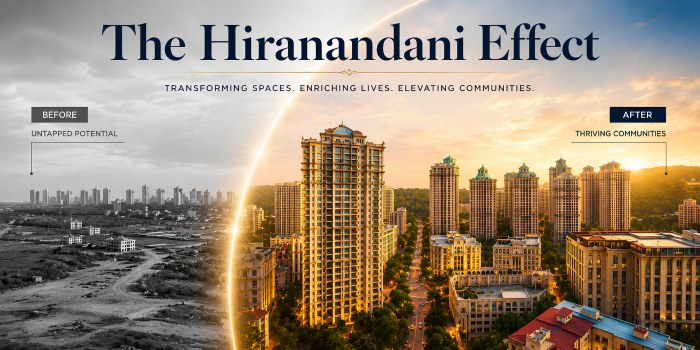
If a development continues creating businesses, employment, and prosperity long after construction has ended, then it has achieved something far greater than appreciation; it has created an economy. That is the true Hiranandani Effect.
Follow Us On Social Media:
Discover more from Niranjan Hiranandani
Subscribe to get the latest posts sent to your email.