

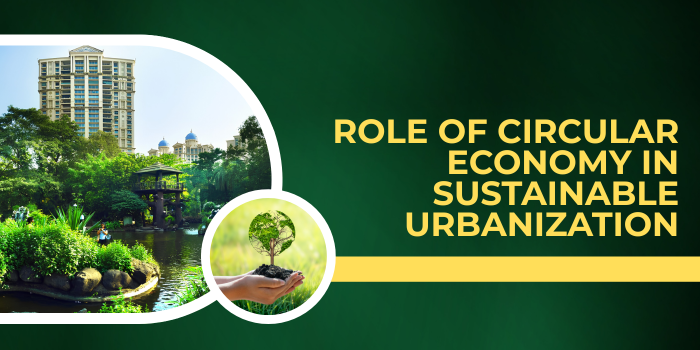
 By
By The current generation lives in an era that is defined by contradictions. At one end, humanity has never been seen as more sound and robust technologically, economically, and intellectually. At the same time, we are confronted by an accelerating convergence of crises. The destabilizing realities of climate change, the relentless pressure of quicker urbanization, and the quiet but dangerous depletion of natural resources.
India stands at the crossroads of these forces. It cannot afford to build its urban future on the same extractive, linear models of the past. World Environment Day, with its emphasis on sustainability and innovation, offers us time to pause, rethink, and reflect on our decisions.
This theme resonates deeply with what I have consistently advocated, that the circular economy is not a niche concept for environmentalists. It is the need of the hour for a better tomorrow. As India moves toward becoming a $5 trillion economy while simultaneously pursuing its net-zero target by 2070, the conversation around growth can no longer remain disconnected from resource efficiency and long-term resilience.
Apart from this, it is also the most practical and powerful approach to building cities that work, economies that flourish, and genuinely prosperous lives.
As we observe geopolitical tensions deepening into full-blown conflicts over energy supplies and critical minerals, self-reliance through circularity has never been more important. This is not merely an environmental argument but a matter of national security, economic sovereignty, and intergenerational responsibility.
How Geopolitical Disruptions Are Reshaping Sustainability Priorities
The conflicts unfolding across the globe today are, at their core, contests over the resources that power modern civilization: oil, gas, critical minerals, and water. What was once the preserve of strategic analysts has become an uncomfortable reality for every government and every economy.
India must read this moment clearly. As a nation, we continue to remain dependent on imported energy and several globally traded raw materials. Any disruption across supply chains, shipping corridors, or energy markets directly impacts manufacturing, infrastructure development, construction costs, and economic stability.
The recent volatility in commodity prices, logistics costs, and energy supply chains has demonstrated how deeply interconnected urban development and global geopolitics have become.
This is where circular economy principles become strategically important. Reduce, Reuse, and Recycle are no longer only sustainability slogans; they are increasingly becoming economic safeguards for the future.
Why Circular Economy Is Becoming Essential for Future Urban Development
The Circular Economy is often misunderstood and narrowly associated only with recycling. In reality, it represents the fundamental redesign of how we produce, consume, and value resources.
In the traditional linear model, developed by industrialists, raw materials are extracted from the earth, products are made and used, and the residue is discarded. The circular model attempts to close this loop by designing systems where resources are reused, regenerated, and optimised over longer life cycles.
‘Circularity is not a constraint on growth. It is about making growth more intelligent, efficient, and sustainable. ’
This becomes particularly relevant for cities, which remain among the world’s largest consumers of energy, water, and materials.
For urban ecosystems, circular principles can translate into:
- buildings designed for long-term resource efficiency
- integrated waste-to-energy systems
- sewage treatment and water recycling infrastructure
- renewable energy integration
- smart monitoring systems for energy and water consumption
- construction practices that minimise material wastage
At Hiranandani, we have consistently believed that sustainability must be integrated into planning from the outset rather than introduced as an afterthought. Across our township developments, the focus has increasingly been on resource optimisation, water recycling systems, green infrastructure, integrated landscaping, and efficient urban planning frameworks that improve long-term sustainability outcomes.
Within integrated township ecosystems, closed-loop approaches such as treated water reuse, sewage recycling, energy optimisation, and efficient infrastructure planning are becoming increasingly important for future-ready urban communities.
How Technology and Smart Infrastructure Can Enable Circular Cities
Technology will play an equally important role in enabling circular urban ecosystems.
AI-led analytics, IoT-enabled sensors, predictive maintenance systems, and smart resource monitoring platforms can help cities optimise energy usage, reduce water wastage, improve operational efficiency, and monitor infrastructure performance in real time. Around the world, countries are investing in technologies that strengthen resource security and unlock greater value for domestic resources. India’s progress in advancing its thorium-based nuclear energy pathway through the Prototype Fast Breeder Reactor at Kalpakkam reflects this thinking, alongside innovations in renewable energy, fertiliser production, and resource recovery.
Future cities will not only be digitally connected; they will increasingly need to become resource-intelligent. This convergence of sustainability and technology has the potential to redefine how Indian cities operate over the next decade.
Why Sustainability Must Become Scalable and Economically Viable
The transformative shift at the scale India requires cannot remain limited to premium developments or isolated pilot projects. Sustainability must become scalable, practical, and economically viable.
One of the biggest misconceptions around sustainable development is that it increases costs. In reality, efficient resource management often lowers long-term operating expenses, reduces utility consumption, improves maintenance efficiency, and enhances lifecycle asset value.
Government frameworks supporting green infrastructure, renewable energy transitions, and sustainable urban development are creating positive momentum. Policies such as GRIHA standards, energy efficiency codes, and green infrastructure incentives indicate that the ecosystem is gradually moving in the right direction.
However, policy alone cannot drive transformation.
Technology and regulation are important, but sustainable urbanisation ultimately depends on behavioural change and collective participation. Environmental responsibility must become embedded within communities, institutions, businesses, and everyday urban living.
Building Resilient Cities for the Next Generation
As I reflect on World Environment Day 2026, one reality becomes increasingly clear: the circular economy is no longer an optional sustainability conversation. It is becoming central to urban resilience, economic stability, and future city planning.
The transition toward circular, sustainable urban ecosystems is not about idealism; it is about preparedness.
Climate change, resource pressures, and geopolitical disruptions are already reshaping how cities will evolve over the coming decades. The question before us is not whether change will happen, but whether we are prepared to adapt intelligently.
India has the opportunity to build some of the world’s most resilient, efficient, and future-ready urban ecosystems. But achieving that will require collaboration between policymakers, urban planners, developers, businesses, and citizens alike.
Because the future of cities will ultimately depend not only on how much we build, but on how responsibly and intelligently we choose to build them.
Follow Us On Social Media:
Discover more from Niranjan Hiranandani
Subscribe to get the latest posts sent to your email.