

 By
By As we transition into 2025, it is critical to analyze the transformative evolution of India’s real estate sector in 2024. The year exemplified the sector’s dynamism through landmark projects, macroeconomic developments, and progressive policy frameworks. Key milestones across residential, commercial, and industrial real estate reflected shifting demographic trends, proactive governance, and technological advancements.
Residential Real Estate: The Pulse of a Growing Nation
The housing market witnessed extraordinary momentum in 2024, fueled by 50% of household savings being allocated to real estate. A significant demographic shift emerged, with younger buyers—averaging 33 years old—dominating the market.
Flagship initiatives like the Affordable Housing Scheme under PMAY continued to make waves, offering first-time buyers access to well-constructed homes. Additionally, Tier 2 and Tier 3 cities emerged as residential hotspots due to improved connectivity and rising employment opportunities.
A distinctive example is the transformative BKC Housing Project in Mumbai, which redefined urban living by integrating eco-conscious designs with high-density housing solutions.
Commercial Real Estate: Engines of Economic Transformation
Commercial real estate flourished, with cities like Bengaluru, Hyderabad, Pune, and the Mumbai Metropolitan Region (MMR) driving demand for Grade A office spaces. The shift towards hybrid work models created opportunities for flexible and co-working spaces.
Additionally, 2024 saw the rise of innovative business districts. For example, the launch of the International Financial Services Centre (IFSC) in GIFT City, Gujarat strengthened India’s position as a global financial hub. This development is expected to attract multinational corporations and foreign investment, enhancing the overall commercial landscape.
Industrial Real Estate: Enhancing National Competitiveness
The industrial and logistics sector experienced a boom in 2024, powered by “Make in India” and the Production-Linked Incentive (PLI) schemes. Manufacturing hubs for electronics, semiconductors, and EV components expanded significantly.
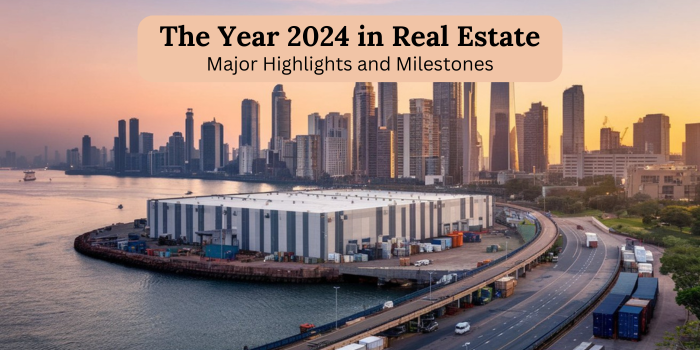
The inauguration of the Dighi Port Industrial Area in Maharashtra stood out as a key development, offering advanced warehousing solutions and multi-modal logistics connectivity. This initiative aligns with the national goal of reducing logistics costs and improving global competitiveness.
Cultural and Urban Milestones: A Year to Remember
2024 wasn’t just about economic growth; it was also about cultural and urban milestones that shaped India’s identity. Alongside the inauguration of the Ram Mandir, developments like the completion of Kashi Vishwanath Corridor Phase II in Varanasi reinforced the link between heritage and infrastructure. These projects have not only enhanced religious tourism but also stimulated local economies, creating ripples across the real estate sector.
Sustainability and Smart Cities: Towards a Greener Future
Sustainability was a key theme in 2024. With India’s commitment to green construction and urban planning, several smart cities adopted renewable energy solutions and IoT-enabled infrastructure. The Chandigarh Smart City Project achieved significant milestones, setting a benchmark for integrating technology with sustainability.
The Road Ahead
As I look to 2025, I see immense potential for the Indian real estate market to build on the foundation laid in 2024. From iconic landmarks to forward-thinking industrial and commercial projects, the year showcased the sector’s ability to shape lives, drive economic progress, and celebrate cultural heritage.
For me, 2024 was a year of purpose and transformation—a year that demonstrated real estate’s power to blend tradition, innovation, and sustainability into a cohesive growth story.
Let’s approach 2025 with renewed optimism and commitment to making India’s real estate sector a global benchmark for excellence.
Discover more from Niranjan Hiranandani
Subscribe to get the latest posts sent to your email.