

 By
By The tale of India’s development has always been linked to natural resources, with water being one of the most essential. Now, as the country is rapidly urbanising and enlarging its infrastructure footprint, water is increasingly considered not just an environmental but an economic and urban development problem.
World Environment Day is a chance to reflect on a fact that is often lost – India’s water problem is not just about scarcity; it’s increasingly about management, governance and sustainability.
India gets just under 4,000 billion cubic metres of rainwater every year. But the problem isn’t water scarcity: it’s about restoration, recycling and reusing it. India has enough rainwater to support almost one-sixth of the world’s population, but it only has around 4% of the world’s freshwater. The problem is not just how much water we can get but how we get it.
India’s per capita water availability has dropped from more than 5,000 cubic metres after independence to around 1,400 cubic metres today due to population pressure, groundwater extraction, and climate change.
Beyond Water Scarcity
Urbanisation is reshaping India’s water challenge. Cities are growing upward and spreading out, increasing the strain on already stressed water systems.
India is one of the biggest users of groundwater in the world, extracting almost a quarter of all groundwater used worldwide. While groundwater has historically met both agricultural and urban demand, overreliance on it has led to long-term risks, including falling water tables and drying aquifers.
Hence, the challenge is not just about drinking and irrigation, and extraction is not enough. Future water planning will require conservation, treatment, reuse and a resilient urban water ecosystem. Water security must become a core part of urban planning, rather than the responsibility of a utility.
Intentional Cities Building Circular Water Systems
The future of urban development fuels an economy where water is not single-use but treated, returned and reused. Integrated townships and planned urban ecosystems are increasingly proving that water management could be integrated into a city’s design. Sewage treatment plants, water recycling systems, rainwater harvesting, optimizing landscape water use and infrastructure planning could all help to ease resource pressure.
At Hiranandani townships, the emphasis has always been on creating integrated systems of treated water reuse for landscaping and other non-potable uses, thus ensuring long-term resource efficiency gains. The lesson here is that sustainability is best achieved when it is built into the planning process rather than being added on later as an intervention.
Technology and Governance
Technology will increasingly play a key role in strengthening water resilience.
AI-enabled predictive systems, IoT-powered sensors, smart metering and cloud-based monitoring systems can detect leakages, regulate consumption and increase operational efficiency. Future cities will need smart systems that can monitor resources in real time, rather than just relying on traditional infrastructure models.
Equally critical is governance.
Water is still a state subject involving multiple institutions in planning and implementation. While programmes such as Jal Jeevan Mission, Atal Bhujal Yojana, AMRUT and Namami Gange have created positive momentum, coordination among policy makers, local bodies, industry and communities will remain critical.
In the future, water “management” will be less dependent on the monsoon and more driven by scientific planning and decentralized implementation, with greater local participation.
Take The Future Forward
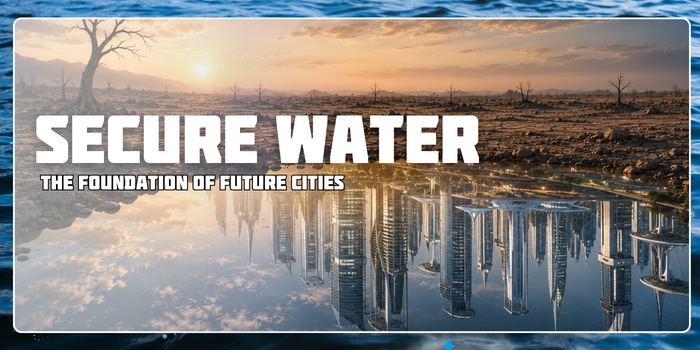
Water security cannot be an afterthought in conversations about urban development. It needs to be part of the core paradigm guiding infrastructure plans, policy making, and city design.
Future cities will not be judged on their skylines or their infrastructure capacity alone. They will be judged by their resilience and the way they manage essential resources.
The question is not whether India has enough water. The question is whether we can build systems that respect, conserve, and manage it judiciously.
Because cities are only as sustainable as the resources they rely upon.
Follow Us On Social Media:
Discover more from Niranjan Hiranandani
Subscribe to get the latest posts sent to your email.