

 By
I find myself thinking less about the entrepreneurs in a room and more about everything that had to exist before they walked into it. Roads, power, housing, a market willing to bet on them. But the entrepreneurs themselves are still the part of this story that moves me most, because everything else I build only matters if someone is bold enough to build on top of it.
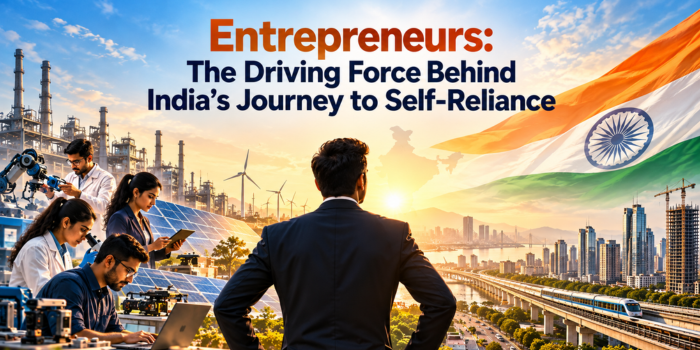
Entrepreneurs are more than business creators. They are innovators, job providers and growth catalysts. We tend to think entrepreneurs create growth. What I have come to believe, after four decades in this business, is that the relationship runs both ways: entrepreneurs need infrastructure to succeed, but it is entrepreneurs, and the confidence they carry into a market, who turn that infrastructure into an economy.
What India’s Entrepreneurs Are Already Proving
Indian entrepreneurs today are making their presence felt well beyond India’s borders, in technology, pharmaceuticals, renewable energy and manufacturing, sectors where the country was, for a long time, seen as a follower rather than a leader. That has changed. Building a business in India demanded resilience, a problem-solving instinct, and a willingness to sit with uncertainty for longer than most people would consider reasonable.
What strikes me most about this generation of entrepreneurs is that their edge is rarely just technical. It is adaptability in the face of markets that shift under their feet, empathy in how they build teams and serve customers, and a genuine instinct for collaboration across borders and cultures. Those qualities do not just build individual companies. Over enough of them, they build a movement, and that movement is what Aatmanirbhar Bharat, a self-reliant India, actually means in practice.
There Is No Glass Ceiling Left
India is all about entrepreneurs. The only real problem has been that entrepreneurs were geared to limit their own ideas, held back by a belief that they could not go beyond a certain ceiling. I do not believe that ceiling exists anymore, for India, for our institutions, or for the sectors we choose to compete in.
People believe they cannot do something, and the moment they disbelieve themselves, they genuinely cannot do it. The scale India’s economy has reached today would have seemed an impossible trajectory to predict only ten years ago. The CEOs of some of the world’s biggest companies are Indians. If an Indian mind can run an American company from the top, there is no reason an Indian entrepreneur cannot build a product company in India that beats the world at its own game. We have largely been service providers to the rest of the world’s product companies. I do not think that has to remain true.
Infrastructure Is the Platform Entrepreneurs Build On
Infrastructure is India’s largest startup. It takes capital before it shows returns, patience before it shows scale, and belief before it shows proof.
Before a startup can succeed, someone has to build the road it ships on, the airport its founders fly through, the power grid that keeps its servers running, and the housing that lets its employees show up every day. Every expressway, metro line, port, airport, data centre and township creates a market before a single entrepreneur walks into it. I think of India’s infrastructure story in four stages: Infrastructure 1.0 connected places, our first roads, railways, ports and electricity. Infrastructure 2.0 connected industries, through expressways and industrial corridors. Infrastructure 3.0 connected cities, through metros, airports and organised retail. We are now entering Infrastructure 4.0, which connects intelligence: AI, cloud, semiconductors, and the skill ecosystems that will train the people to run all of it. Each stage created a different kind of entrepreneur, and I believe Infrastructure 4.0 will do the same.
On a personal note, Mumbai-Pune Expressway upgrades have taken a drive that used to cost me five hours down to about two and a half hours. The Mumbai Trans Harbour Link has done something similar between South Mumbai and Navi Mumbai. That is the clearest way I know to describe what infrastructure gives an entrepreneur: hours back in the week, hours that would otherwise be spent in traffic instead of building something.
Where the Next Wave of Entrepreneurs Will Build
I believe the most interesting opportunities ahead sit in two different places.
The first is AI infrastructure. Twenty years ago, roads connected our cities. Today, cloud connects our businesses. Tomorrow, AI will connect our intelligence. Yotta, where I serve as Chairman Emeritus, currently operates more than 10,000 Nvidia GPUs in live production, and has announced plans to scale beyond 80,000 Nvidia GPUs by FY27. I mention this not to make a case for one company, but for a category. A generation ago, no one questioned why a nation needed more roads. I do not think we should question, today, why a nation needs more compute, and I expect a meaningful share of India’s next generation of entrepreneurs to build on exactly that infrastructure.
The second is less glamorous but just as entrepreneurial. India’s real estate and infrastructure sector is short by roughly 2 million skilled workers today, carpenters, fitters, plumbers, electricians, a gap that could widen to around 5 million over the next four to five years even as the sector targets strong growth. I see that less as a crisis and more as an unbuilt business. India has already shown, through decades of IT talent working globally, that skilled people sent abroad can bring enormous value home. There is real entrepreneurial opportunity in whoever builds the training pipelines to make that happen at scale.
A Personal Note on Staying Adaptable
None of this works without entrepreneurs willing to keep learning past the point where it feels comfortable, which I consider the most underrated soft skill any founder can have.
My father, Dr L. H. Hiranandani, was one of India’s early head and neck cancer surgeons. At the age of 80, he told me over a cup of tea that he was flying to Germany to learn a new operation from a doctor nearly two decades younger than him, a doctor who had, years earlier, come to India to learn a technique from my father. I asked him how that made sense. He said the operation was new, and he wanted to learn it.
I think about that story often. Not long ago, a young colleague in my office corrected me for asking her to run a task through a tool that, in her words, was not the right one for that particular job anymore, and pointed me instead toward a newer one better suited to it. It was a small moment, but a useful reminder: staying relevant is less about mastering one tool for good and more about continually learning which tool fits the task in front of you.
Entrepreneurs Are What Make Infrastructure Matter
Good infrastructure signals that a place is worth betting on. That signal attracts capital. Capital creates jobs. Jobs concentrate talent. Talent, in the hands of the right entrepreneur, produces innovation. Innovation increases consumption, and consumption funds the next round of infrastructure. Infrastructure builds the platform; entrepreneurs are what convert that platform into innovation, employment and economic value. Neither moves this decade forward alone. This decade will belong to the country that builds both, and to the entrepreneurs who have the courage to build on what gets put in front of them.
Dr Niranjan Hiranandani is Co-founder, Hiranandani Group; Founder and Chairman, Hiranandani Communities.
Follow Us On Social Media:
Discover more from Niranjan Hiranandani
Subscribe to get the latest posts sent to your email.