

 By
By Having watched India’s real estate market evolve over several decades, I have seen the meaning of ownership change with every generation. The aspirations of the Indian consumer have moved from simply acquiring more to creating better. A home that once represented achievement and financial security is increasingly expected to contribute to the quality of life its owner wants to build.
India’s second-home market is now entering the next phase of this evolution.
There was a time when owning a second home was viewed largely as a sign of success. It represented financial achievement, offered a weekend escape and was often considered an asset expected to appreciate over time. Its value was measured largely in location, square footage and returns.
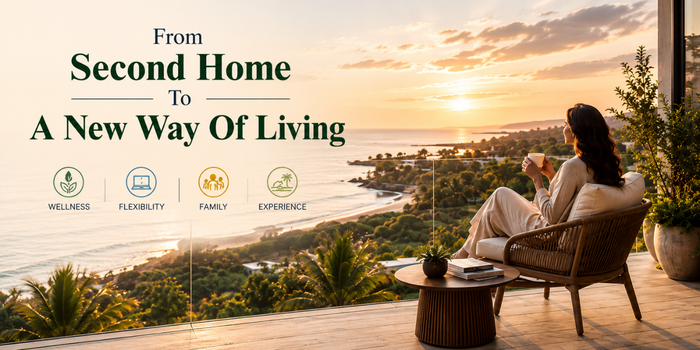
Today, those factors still matter, but they are no longer the complete story. The psychology of second-home buyers is changing as consumers place greater value on time, wellness, flexibility, family and experiences. The second home is increasingly being considered not simply as another asset, but as another way of living.
As economies mature and aspirations become more sophisticated, prosperity is no longer defined only by what people own. It is increasingly reflected in how they spend their time and the quality of life they can create.
The question is gradually changing from “What more can I own?” to “How do I want to live?”
A second home, therefore, is becoming less about escaping life and more about redesigning it.
From Possession to Lifestyle Choice
Consumer psychology has always evolved alongside economic progress. For decades, material ownership was closely associated with achievement. Larger homes, luxury automobiles and premium addresses became visible symbols of prosperity. While these aspirations continue to matter, they are increasingly being complemented by a desire for experiences, well-being and greater control over time.
Today’s affluent consumer values time, health, flexibility and emotional well-being alongside financial growth. This is changing the very meaning of second-home ownership.
Rather than being viewed simply as an additional property that remains vacant for most of the year, a second home can become an extension of one’s preferred lifestyle. It offers an environment where individuals can step away from the intensity of city life without necessarily disconnecting from professional or personal commitments.
Research supports this shift. A 2022 Savills study, reported by The Economic Times, identified accessibility, space and wellness amenities as important considerations for second-home buyers and highlighted the emergence of “hybrid living” splitting time between a primary city residence and a second home.
The broader demand signals are also significant. Knight Frank India’s India Buyer Survey 2021 found that nearly 40% of respondents across income segments were more likely to consider buying a second home following the pandemic. The research linked this interest to lifestyle considerations, outdoor space and privacy.
This represents an important change in consumer behaviour. The second home is no longer necessarily a place visited for a few weekends a year. For some buyers, it is becoming a place where work, family, recreation and personal time can coexist.
The value lies not in any one of these elements individually, but in the way they come together.
This is where second-home ownership begins to take on the character of an intentional lifestyle choice. It is no longer simply about having another address. It is about creating another environment in which one can live, work when required, recharge and spend meaningful time with the people who matter.
Wellness Is Becoming Part of the Return
Perhaps the strongest forces influencing the psychology of second-home buyers in India today are wellness and the search for balance.
Health is no longer viewed only through the lens of healthcare. Increasingly, people are conscious of how their surroundings influence their routines and well-being. Access to greenery,
Open landscapes, natural light, quieter surroundings and opportunities for physical activity can all contribute to a different quality of everyday life.
This shift is visible across the broader luxury housing market as well. Recent reporting in The Times of India points to a growing preference among affluent homebuyers for wellness-led living, thoughtful design, sustainability, privacy and community alongside traditional measures of luxury.
For second-home buyers, the relevance is particularly clear. A home outside the city can offer something increasingly difficult to find within dense urban environments: the ability to build healthier routines around nature, movement, family and time.
The return on a second home is therefore expanding beyond financial metrics. It can also be measured in morning walks instead of traffic, outdoor recreation instead of screen time, family meals without the pressure of city schedules and the ability to slow down without completely disconnecting from everyday life.
A financial asset can appreciate. But a home that enables healthier routines, deeper relationships and more meaningful experiences can create another form of wealth one that cannot always be captured on a balance sheet.
Flexibility Has Become a New Dimension of Luxury
The pandemic changed the relationship between work and place, but the post-pandemic reality is more nuanced than a simple shift to remote work.
In India, office-based work remains strong. JLL’s Future of Work Survey 2024 – India Insights found that 90% of Indian organisations have at least three days of office presence per week, higher than the global average of 85%. The survey also found that 54% of organisations expect the number of days spent in the office to increase by 2030.
For the second-home market, the implication is not that everyone can work permanently from elsewhere. It is that people have greater flexibility in how they organise portions of their time.
A second home can function as a seasonal residence, a place for extended family stays, a temporary work base or simply an environment in which people can spend longer periods away from the city. Improved digital connectivity and changing work practices make these possibilities more practical for some households.
Instead of compressing leisure into a few weekends each year, families can spend longer periods together, children can experience nature beyond short holidays, and professionals can structure their schedules around both work commitments and personal priorities.
The luxury here is not simply the property. It is the ability to decide where and how to spend one’s time.
Time is increasingly becoming one of the most valuable forms of luxury.
Building Memories Instead of Merely Passing Down Assets
The emotional dimension of second-home ownership is becoming equally significant.
Traditionally, inheritance has been viewed largely in financial terms. Homes were assets passed from one generation to the next. Today, families are beginning to think about legacy more broadly.
A second home can become a place where generations come together, where grandparents spend meaningful time with grandchildren, where festivals are celebrated and where family traditions continue beyond the pace of city life.
Children may not remember the market value of a property. They will remember learning to ride a bicycle on quiet roads, watching sunsets together, family dinners over long weekends and conversations made possible because everyone finally had the time to slow down.
In many ways, a second home can become a legacy of shared experiences. Its greatest value may lie not simply in ownership, but in memory.
This reflects a broader understanding that emotional wealth deserves as much attention as financial wealth. The second home can become an asset that generates something that cannot be captured on a balance sheet: time together.
In an increasingly accelerated world, that may be one of the most meaningful forms of wealth a family can create.
From Holiday Homes to Sanctuary Townships
As consumer expectations evolve, the way second-home communities are planned must evolve with them. This is where the idea of the Sanctuary Township becomes relevant.
A holiday home is primarily a place to visit. It offers privacy, a change of scenery and an escape from the city, but its functionality is generally centred around occasional stays.
A second home goes a step further. It is an owned residence that can be used more regularly and for multiple purposes across the year. It can become a place for family holidays, extended stays, personal recreation or, for some owners, a more regular part of their lifestyle.
A Sanctuary Township goes further still.
Unlike a conventional holiday home or second home, a Sanctuary Township is an integrated environment planned around the life that takes place between visits. It brings together residential spaces with nature, wellness, recreation, community, hospitality and everyday conveniences so that the destination itself becomes part of the lifestyle.
That distinction is important.
If the second home is evolving into a more intentional way of living, the development surrounding it must support that evolution. People want environments where they can exercise outdoors, spend time with family and neighbours, pursue recreation, work when required and access everyday conveniences without giving up the tranquillity that brought them there in the first place.
The shift, therefore, is from creating a place people occasionally visit to creating a community in which they can meaningfully live for portions of the year.
This is the essence of the Sanctuary Township: a planned environment where a second home is not merely a residence, but the centre of a broader lifestyle ecosystem.
For developers, this represents a significant change in planning philosophy. The focus moves beyond the house itself towards the quality of the environment, the experiences it enables and the community it creates.
And as this model evolves, the next question is: which destinations are best positioned to support this new way of living?
Why Alibaug Fits the New Second-Home Mindset
Few destinations illustrate the changing psychology of second-home buyers in India as clearly as Alibaug.
Having observed Mumbai’s expansion over the years, I have seen how improved infrastructure can change not only travel patterns but also the way people perceive a location. Connectivity does more than reduce travel time; it changes the psychological distance between places.
Alibaug’s relationship with the Mumbai metropolitan region is evolving as connectivity improves. The Atal Bihari Vajpayee Sewri–Nhava Sheva Atal Setu has strengthened connectivity between Mumbai and Navi Mumbai, while M2M Ferries provides year-round Ro-Pax connectivity between Mumbai and Mandwa.
The significance is not simply faster travel. Improved accessibility makes it more practical for people to spend longer periods there rather than treating Alibaug purely as an occasional weekend destination.
At the same time, the region is seeing greater interest in organised residential, hospitality and lifestyle formats. This is gradually creating a more complete lifestyle ecosystem around the destination.
That evolution matters because a destination becomes a lifestyle environment when people no longer visit for just one reason. They may come for the landscape, stay for the experience, spend time with family, pursue recreation, work when necessary, and gradually develop a deeper relationship with the place.
Alibaug’s coastal setting, open spaces and established leisure appeal provide the natural foundation, while improving connectivity and an emerging lifestyle ecosystem are creating the conditions for more sustained engagement with the destination.
Consumers are not necessarily looking to escape urban life altogether. They are looking to complement it.
For Mumbai-based buyers, Alibaug increasingly represents an opportunity to access nature, family time and a slower pace of living without completely disconnecting from the city.
In that sense, Alibaug reflects the broader evolution of the second-home market from a place to visit to a place in which to live differently.
A New Vision for Second-Home Living
This changing consumer mindset is also influencing how integrated communities are being conceived.
The Sanctuary Township provides a useful lens through which to understand this next stage of second-home development. If the second home is becoming an intentional extension of one’s lifestyle, the community around it must evolve from a collection of holiday residences into an ecosystem that supports that choice.
This is where Hiranandani Sands Alibaug, an integrated township proposition in Alibaug, becomes relevant not simply as a residential development, but as an example of how the Sanctuary Township proposition can be applied to a destination such as Alibaug.
The broader idea is to bring together sea, sand and sanctuary: the natural setting of the coast, the recreational character of a destination and the sense of a planned environment in which people can spend meaningful time.
Hiranandani Communities has positioned Hiranandani Sands Alibaug as a 225-acre integrated township. Its first phase comprises residential development, while the larger township proposition encompasses a broader mix of residential, hospitality and lifestyle components.
The relevance of such a model lies in the changing expectations of the second-home buyer.
Someone may want to spend a weekend there, stay for an extended period with family, pursue wellness and recreation, or simply create more time away from the intensity of the city.
That is the essence of the Sanctuary Township. It is not merely a destination; it is an environment designed around the life people want to lead.
When a second home is viewed purely as an asset, the emphasis naturally falls on location, configuration, price and appreciation.
When it is viewed as a lifestyle proposition, the questions become broader:
Does this place support my well-being? Can my family spend meaningful time here? Can I work when I need to?
Can I reconnect with nature?
Does it offer recreation and community? Can I build memories here?
These are no longer simply real estate questions. They are questions about how we want to live.
The Future of Second-Home Ownership Is Psychological Before It Is Physical
Real estate has always reflected changing human aspirations. As aspirations evolve, so do the homes people choose.
The emerging generation of second-home buyers is not simply seeking appreciation, prestige or occasional leisure. Increasingly, they are looking for environments that support health, family relationships, flexibility, connection with nature and a more balanced way of living.
In many respects, the second home has ceased to be merely an accessory to success. It is becoming part of a broader strategy for living well.
Wellness, flexibility, family, nature and work-life balance are no longer separate considerations. Together, they are shaping a more conscious approach to second-home ownership in India.
This is perhaps the most important shift taking place. The second home is moving from being an additional possession to becoming an intentional extension of the life one wants to create.
As destinations such as Alibaug continue to mature, and as integrated communities respond to changing expectations, the future of second-home ownership will be defined less by status and more by purpose.
Ultimately, the most valuable investment may no longer be the one that delivers the highest return on paper.
It may be the one that delivers the richest quality of life.
Because the real question behind the next generation of second-home ownership is no longer simply:
“What do I own?”
It is:
“What kind of life does this home allow me to live?”
Sources
- Knight Frank India — India Buyer Survey 2021
- JLL — Future of Work Survey 2024: India Insights
- The Times of India — Luxury homebuyers ditch ‘bigger is better’ as wellness and design emerge as top priorities
- M2M Ferries — Official website and Mumbai–Mandwa Ro-Pax connectivity
- Prime Minister’s Office — Atal Bihari Vajpayee Sewri–Nhava Sheva Atal Setu
- Hindustan Times — Hiranandani Communities launches 225-acre township project in Alibaug
- The Economic Times — Savills research on second-home buyer preferences
Follow Us On Social Media:
Discover more from Niranjan Hiranandani
Subscribe to get the latest posts sent to your email.