

 By
By I congratulate the government of India for taking another important step toward the Mumbai 3.0 vision by developing the Mumbai-Pune expressway. This milestone highlights the country’s strong commitment to building top-quality infrastructure for long-term growth. With Shri Nitin Gadkari’s leadership, these projects are changing how India moves, works, and grows. These investments will boost Maharashtra’s economy, make travel easier, improve productivity, and create new opportunities for both businesses and communities. This project also helps connect Mumbai and Pune more closely.
Expanding Navi Mumbai–Pune Coverage: The New Growth Arc
Navi Mumbai and Karjat have long played key roles in the growth of the Mumbai Metropolitan Region (MMR). With the new expressway running from Atal Setu to Pune and passing by these areas, we will see much better connections between these sub-regions and the wider Western Maharashtra economy. This is more than just a road; it will greatly improve access for residents, businesses, and industries.
The eight-lane, high-capacity, access-controlled corridor ensures that Navi Mumbai becomes more deeply integrated into the industrial belt spanning Panvel, Karjat, and ultimately Pune, accelerating land use optimization and balanced regional development.
Ease of Commute and Business Accessibility
This is not just a question of convenience; it heralds a fundamental rethink of the relationship between distance and opportunity. To daily commuters and business people who have to put up with unpredictable journey times because of congestion on the existing expressway, this will be a game-changer. A 90-minute intercity commute extends the labor catchment area, hastens decision-making, and can make cross-city business collaboration far easier than ever before.
I believe this will attract talent not just from the immediate region but also from neighboring states, as it helps bridge the gap between where people live and where they work.
Port, Airport & Logistics: A Freight-Forward Advantage
The fact that the proposed and developed multi-modal transportation through the corridor brings the road, sea, and air transport networks together in Navi Mumbai port and airport puts the latter’s stature as an international logistics destination on the fast track. The fact that the JNPT, now the country’s largest container handling port, and the successfully operational Navi Mumbai International Airport are set to bring unprecedented benefits to the transportation of commodities. Thus, through this partnership, we will see a significant decline in logistics and transportation costs, which in turn will aid manufacturers and exporters.
Talent Shuffle: India’s Changing Work–Live Landscape
One of the most evident yet understated outcomes of this corridor will be the redistribution of talent across the region. Now that the expressway is in the picture, the commute time will compress, and accessibility will improve. Working professionals will no longer be compelled to stay close to traditional business districts. Navi Mumbai, Panvel, Kajrat, and even Pune’s peripheral zones will emerge as highly attractive residential and commercial hubs.
This ‘talent shuffle’ will ease pressure on Mumbai’s overburdened urban core while fostering new micro-economics along the corridor. Companies will now have access to a wider talent pool, employees will benefit from a better quality of life, and the best part is that cities will evolve in a more sustainable, decentralised manner. Over the period of time, this could redefine the classic Mumbai-centric employment model into a multi-node economic system.
Real Estate & Urban Development: Catalysing Planned Growth
Infrastructure has always shaped how cities grow, and the upcoming expressway is set to be a real game-changer for Navi Mumbai and Panvel. Better connectivity doesn’t just cut travel time; it boosts land values, attracts businesses, and creates a strong demand for well-planned, integrated townships.
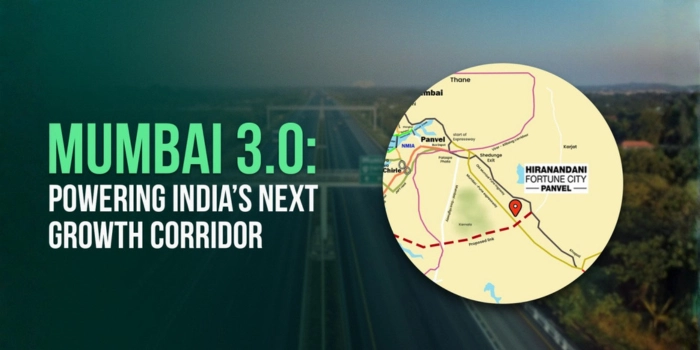
This shift is already visible on the ground. Leading developers are making long-term bets on the region. Hiranandani Group’s Fortune City in Panvel brings together homes, offices, retail, and community spaces in one integrated development. Adani Realty’s large-scale Panvel Township reflects strong confidence in the area’s future, while Godrej Properties and The Wadhwa Group are adding lifestyle-focused townships near key transport corridors. Together, these developments show how strong infrastructure, led by the Mumbai–Pune Expressway, is shaping a more organised and sustainable urban future for Navi Mumbai and beyond.
A Corridor of Opportunity, Not Just Connectivity
The Mumbai–Pune Expressway extension goes far beyond being a mere infrastructure project. It functions as a vital economic artery, seamlessly linking finance, manufacturing, logistics, talent, and global commerce into a highly efficient corridor. Aligned with India’s ambition to emerge as a global manufacturing and logistics powerhouse, the expressway strengthens the nation’s economic framework.
As Maharashtra continues to position itself as one of India’s leading economic engines, this corridor will significantly influence how people live, work, and move in the years ahead. More than just reducing travel time, it unlocks new avenues for competitiveness, productivity, and long-term growth.
Discover more from Niranjan Hiranandani
Subscribe to get the latest posts sent to your email.
1 Comment
Comments are closed.