


 By
By Indian real estate is sensing the undercurrents of a transforming luxury landscape, and this shift has little to do with bricks or blueprints. Over the decades, the sector has evolved through distinct phases: from speculative land plays to integrated townships, from affordable housing to vertical urban living, and now from location-led value to lifestyle-led differentiation. Each transition appeared gradual until it became unmistakable. Today, a similar inflection point is emerging in which the space and service industries are strategically aligning their strengths to expand their market relevance.
Hospitality and real estate are quietly converging, combining the tangible strength of developed assets with the intangible power of brand equity and service excellence. Luxury hotel brands bring decades of trust, emotional recall, and operational discipline, while real estate provides the physical canvas. Together, they are redefining what premium living means.
As these boundaries blur, the temporary indulgence of a five-star stay is being reimagined as a permanent way of life. This is not merely a passing trend; it signals a structural reset in how luxury housing will be conceptualized, positioned, and experienced in the years ahead.*
At its core, this convergence responds directly to the evolving aspirations of the modern homebuyer, someone who seeks more than ownership. The demand today is for homes that 3function as both investment-grade assets and experience-led living environments. In this new paradigm, real estate delivers the asset, while hospitality elevates the experience together, creating a more holistic, future-ready definition of luxury living.
The New Blueprint of Luxury Living
This convergence is taking shape through two distinct but complementary models within luxury real estate trends in India:
1. Branded Residences
Privately owned homes developed in partnership with luxury hotel brands. While ownership lies with the buyer, the hospitality partner defines and maintains service standards.
What sets them apart:
- Concierge, valet, housekeeping
- Dining, spa, wellness ecosystems
- Globally benchmarked service standards
- Long-term brand-led asset management
2. Serviced Apartments
A hybrid investment-lifestyle model.
How they function:
- Units owned by individuals
- Managed within a rental pool
- Income generated when not in use
- Fully operated by professional hospitality players
This is an asset-light, brand-heavy strategy in which hospitality companies expand their reach without heavy capital deployment, while developers unlock premium positioning.
Why Developers Are Leaning In?
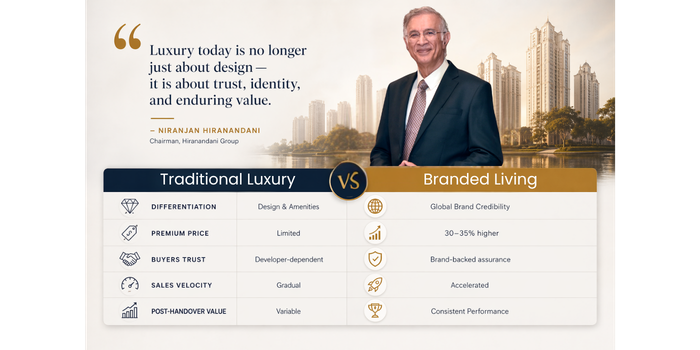
In a market where every project claims “luxury“, differentiation has become increasingly difficult. Branded residences in India offer a powerful answer.
This shift clearly signals that brand-backed living is not just about perception; it directly impacts pricing power, absorption, and long-term asset performance.
Why India, Why Now?
At Hiranandani Communities, this convergence is not a future bet; it is already being operationalized. Our developments in Alibaug are being positioned at the intersection of real estate and hospitality, capitalizing on Alibaug real estate growth, where homes are designed not just as assets but as curated living experiences. The introduction of branded serviced apartments reflects this shift, blending investment potential with lifestyle-led usage in a market that is rapidly evolving beyond second-home demand.
Several forces are converging:
Demand Drivers
- Rapid growth in the HNI and UHNI population
- Global exposure to branded living in cities like Dubai, London, Singapore
- Increasing preference for experience-led ownership
- Rising appetite for investment-grade residential assets
Supply-Side Evolution
- Developers seeking credible differentiation
- Hospitality brands shifting to asset-light expansion models
- Institutional capital favouring branded, managed assets
Read Blog: Alibaug’s Coastal Renaissance: Unlocking Maharashtra’s Blue Economy with the Revas–Karanja Bridge
The Investment Perspective
This convergence is not just a product innovation; it is the emergence of a distinct asset class.
Global Insights (Indicative Trends)
- 20–35% price premium over comparable luxury assets
- Higher rental yields in serviced formats
- Stronger resilience during market cycles
- Greater appeal to international buyers
India’s Position
India is still in the early stages of this curve. The partnerships and projects being shaped today will set benchmarks for decades to come. The early movers in Branded Residences India and Serviced apartments investment will define pricing benchmarks and buyer expectations for the next decade.
Stakeholders’ Gains
For Developers
- Move beyond construction to curation of experience
- Partner, selectively, brand fit matters more than brand name
For Hospitality Brands
- Scale through management and brand equity, not just ownership
- Protect long-term credibility through operational involvement
For Buyers & Investors
- Evaluate the depth of brand integration, not just association
- Focus on long-term service sustainability and resale dynamics
However, the success of this model depends heavily on execution, true integration between developer and operator, not just brand licensing.
The Larger Shift
For over a century, the hospitality industry has mastered one craft, making people feel at home when away and real estate has been at its core, serving home as an experience rather than just a tangible asset.
Hence, the industry is now witnessing the best of both worlds collaborating, which will change the ballgame of luxury real estate in India in its true sense.
Final Thought
The best real estate has never been about structures, it has always been about the experience it offers. Branded residences in India are a shot in the arm, where experiential living is not just a destination but a daily experience.
Follow Us:
Discover more from Niranjan Hiranandani
Subscribe to get the latest posts sent to your email.